 BestSubscribers
Should You Create an Online Course? (An Honest Answer)
Yes — if you have real expertise and an email list to sell to.
An online course is the highest-leverage way to monetize what you know. We're talking 95%+ margins, no client calls, and the ability to sell the same product for years after creating it.
But most guides skip the part that actually matters: whether your audience will buy, and how you'll know which of your content drives those sales.
I've launched over 90 courses in the past decade. Some generated 6 figures. Others made a few dozen dollars. The difference was never content quality — it was knowing which content attracted the right audience. Below: the real economics, the 3 types of courses worth considering, the honest downsides, and the one metric most course creators never track.
Online Courses Are the Best Leverage Play for Solo Creators
There are really only 4 ways to make money from your expertise: sell ads, promote affiliate products, offer coaching, or sell your own products.
Coaching trades time for money. There's a hard ceiling on how many people you can help in a day. Affiliates give up control — you're at the mercy of someone else's program, commission rates, and how they treat your audience. Ads require massive traffic and usually favor the belly-button-showing influencer crowd.
Online courses give you full control. What's inside, how you deliver it, what you charge. They cost almost nothing to produce. You need a computer, screen recording software, and about 10 hours.
And here's something nobody talks about: the same information packaged as an ebook sells for $1.99. Wrap that same info into a video course with some handouts, and suddenly it's worth $200+. Same brain. Same expertise. Different wrapper. That's the leverage.
I generate roughly 85% of my revenue from online courses. And I'm an introvert who works only in the mornings. No Zoom calls required. No DMs. Just deliver your smarts, create a checkout page, and send some emails.
The 3 Types of Online Courses (And Which One to Start With)
Not all courses are created equal. The type you choose determines how fast you can launch and how much you can charge. Most guides treat "online course" as one monolithic thing. It's not.
The Flagship Course ($1,000–$2,000)
Bundle everything you know into one giant course and slap a premium price tag on it.
The problem: selling at this price point requires serious marketing skills. The kind most people don't have when they're starting out. If you can't write a compelling sales page and run a launch sequence, this model will frustrate you.
The Mini-Course ($17–$97)
A small product. Usually one hour or less. Low risk, quick to create.
But the math tells a different story. Say you have 2,000 email subscribers and a $100 course. At a 3% conversion rate, that's 60 sales per year. $6,000 total. Not bad — but it's not replacing your job either.
The A La Carte Course ($200–$500) — The Sweet Spot
Think of it like a restaurant menu. You're not offering the entire buffet. Just a few specific dishes that solve specific problems.
Break down your domain of expertise and create targeted courses for each problem your audience faces. If you teach email marketing, instead of one giant "email marketing mastery" course, you could have separate courses on writing emails, automation, deliverability, growing your list with SEO, growing your list with LinkedIn.
Price each one between $200 and $400. Create them quickly — less than a week each. Build up a library over time.
This is the strategy that allowed me to build a quiet 6-figure business working only in the mornings. No single course made me a millionaire overnight. But stacking them up, month after month, with a growing email list buying from a growing catalog? That compounds.
You Don't Need a Huge Audience (But You Need the Right One)
There's a myth that you need tens of thousands of followers before selling a course. You don't.
Here's the math: 100 qualified email subscribers buying a $100 product each month = 6 figures per year. Kevin Kelly's famous "1,000 True Fans" argument says you only need 1,000 people who spend $100/year on what you sell.
The keyword is qualified.
A qualified subscriber isn't someone who just opens your emails. It's someone who buys. Repeatedly. And the difference between a list full of buyers and a list full of freebie seekers comes down to what content attracted them in the first place.
Teachable's data across 23,000+ course creators shows that when you launch a product to your email list, around 2% of subscribers convert. With just 1,000 subscribers and a $300 course, that's $6,000 from a single launch.
But that 2% average hides massive variation. Some creators see 5%+ conversion rates. Others get 0.5%. The difference isn't the sales page or the launch sequence. It's whether the right people are on the list — and that starts with the content that brought them there.
The Honest Downsides Nobody Talks About
I'd be lying if I told you courses are all upside. Here's what actually trips people up.
Most Courses Get Created, Not Completed
Industry completion rates hover between 5% and 15%. That sounds terrible — and it is, if you're building 25-hour encyclopedias.
Short courses focused on one transformation do better. A 2-hour course solving a specific problem will have dramatically better completion than a sprawling mega-course. This is a design choice, not a course-model flaw.
People aren't buying your course to learn everything you know. They're buying it to solve a problem. Think of going to a surgeon — you're not paying them to recite everything they learned in medical school. You want the fix.
You Still Need to Market the Thing
A course isn't a "build it and they come" product. The creation is maybe 30% of the work. The other 70% is getting the right eyeballs on it.
Email marketing is the engine. Your launch emails, your nurture sequences, your weekly content — that's what sells courses. If you don't have an email list, start building one before (or alongside) creating your course. The two are really sides of the same coin.
Analysis Paralysis Is Real
A lot of people get stuck in perfectionism mode. They think a course needs to be a Hollywood production. It doesn't.
Your first version will be imperfect. Ship it anyway. You can improve it later with student feedback. The creators who make money are the ones who launched, not the ones who spent six months polishing slide 47.
Course vs. Coaching vs. Membership: A Decision Framework
A course isn't always the right first product. Sometimes coaching gets you there faster.
Here's why: when you're selling courses, you're guessing what people need. You're throwing spaghetti at the wall. But your audience is a mix of different needs, different pain points, different stages.
A better starting point? A simple coaching offer. Something like: "I'll help you do X in Y days." Price it at $50 or $97. Talk about it in your emails for a week. Add a deadline.
If people pay $50, they'll pay $500 later. If nobody bites at $50, you just saved yourself months of building the wrong course.
Once you've worked with a few clients, you'll see patterns. They ask the same questions. Struggle with the same steps. Give the same feedback. That's when you build the course — because now you know exactly what to include.
Even better: combine both. Half course, half coaching. I call it a Hybrid Coaching Program. You create a small course component teaching the theory. Your live calls focus on implementation and feedback. Charge 5–10x what a standalone course costs.
10 clients at $500/month with one group coaching call per week? That's $5,000 from just an hour of weekly calls. The course content? Create it once. It keeps working for you.
The Real Question Nobody Asks Before Creating a Course
Every guide about creating online courses talks about platforms, pricing, and launch strategies. Almost none of them ask the question that matters most:
Which of your content actually attracts buyers?
I have a YouTube video with over 160,000 views. It generated zero customers. Not one.
Another video with fewer than 3,000 views brought in thousands of dollars in course sales.
If I'd looked at my analytics the way most creators do — views, likes, shares — I would have doubled down on the viral stuff and killed the content that was quietly making me money.
Platform metrics are fake dopamine. They give you the illusion you're doing something right when the numbers that actually matter tell a completely different story.
The problem is, the platforms you publish on don't connect the dots:
- Instagram won't tell you which posts generated email subscribers
- LinkedIn won't show which articles led to course sales
- YouTube won't connect views to revenue
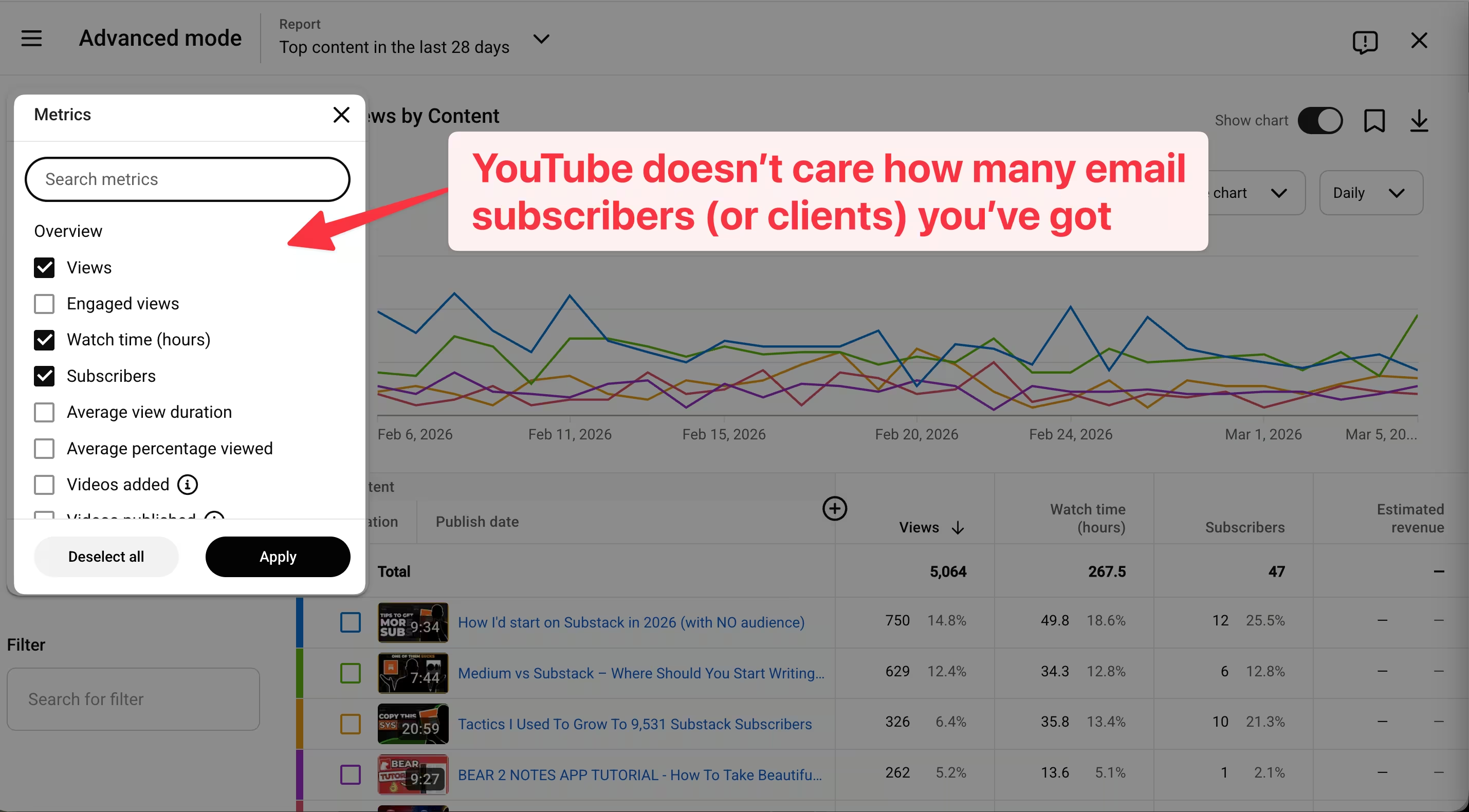
I tried tracking this myself for years. Spreadsheets. UTM parameters. Zapier automations held together with duct tape. Even then, at least 30% of my revenue went untracked.
Without this data, you're making course creation decisions blind. You might build a course around a topic that gets views but attracts zero buyers. Or worse — you might ignore the content that's quietly pulling in your best customers.
That's exactly why I built BestSubscribers. It connects every subscriber back to the exact piece of content that brought them in — and tracks whether they ever bought. So instead of guessing which content topic to build your next course around, you're looking at a screen that tells you: this article made you money, that one didn't, here's where to focus.
How to Actually Get Started (Without Wasting Months)
If you've read this far and you're thinking "okay, I want to do this" — here's the shortest path I know.
Pick one specific problem your audience has. Not a broad topic. A problem. "How to write cold emails that get replies" is a problem. "Email marketing" is a topic. Courses sell when they solve problems.
Create a short course solving it. Price it between $200 and $400. Record your screen walking through the solution. Talk through your process the same way you'd explain it to a friend over coffee. Two hours of finished content is more than enough.
You don't need fancy equipment. A computer, screen recording software (many are free), and 10 hours total — including the sales page and launch emails.
Repurpose what you already have. Your best blog posts, email sequences, and social content are raw material. You've probably already written 80% of a course without realizing it.
Validate before you build. Offer a $50 coaching session solving the same problem. If people pay, build the course. If they don't, test a different problem. This $50 test can save you 3 months of wasted work.
Connect your email platform and payment processor from day one. Kit, MailerLite, or AWeber for email. Stripe or Teachable for payments. And something that tracks which content actually drives your enrollments, so every future course gets easier to sell.
The creators who build sustainable course businesses aren't the ones with the biggest audiences. They're the ones who know exactly what content brings in subscribers who buy — and create more of that.
Start small. Validate fast. Measure from day one.
It ranges widely depending on your list size, price point, and how well your audience matches the course topic. With 2,000 email subscribers and a $200–$400 course, realistic first-year revenue is $6,000–$24,000. Creators with larger lists or course libraries can scale well beyond that. The math gets friendlier the more courses you stack.
The global e-learning market is projected to reach $406 billion in 2026 — and it's still growing. The window isn't closing. But generic "teach everything" courses are dying. Specific, transformation-focused courses that solve one clear problem for one clear audience are what sells now.
You don't need to be the world's best at your topic. You need to solve a specific problem for a specific group of people. If people regularly ask you the same questions — about your profession, a skill you've built, or a transformation you've been through — that's your course. Imposter syndrome is normal. It's also irrelevant if your course helps people get results.
A focused, transformation-based course can be created in about 10 hours. Spread over 2 hours a day, you could launch in a week. The most common mistake is trying to teach everything you know. The fastest (and most profitable) courses solve one problem well — not twenty problems poorly.
Popular options include Teachable, Thinkific, Kajabi, and Gumroad. Each has tradeoffs around pricing, features, and ease of use. The platform matters less than most people think. What matters more is having an email list to sell to and knowing which content drives enrollments. Pick a platform, launch, and optimize later.
No. With 1,000 email subscribers and a $300 course, a 2% conversion rate earns you $6,000 per launch. The size of your audience matters less than the quality — 100 subscribers who trust you and have the problem your course solves will outperform 10,000 random followers every time.

Ready to see which content makes you money?
Stop guessing. Start tracking content to revenue.
Start Free Trial