 BestSubscribers
Should I Start a Podcast? (Brutal But Honest)
Starting a podcast is worth it if you genuinely enjoy talking, have a defined audience, and are willing to commit for 6–12 months with no visible payoff.
But for most creators selling courses, coaching, or digital products through an email list, podcasting is one of the slower and harder content channels to turn into revenue.
That's not what most podcast guides will tell you.
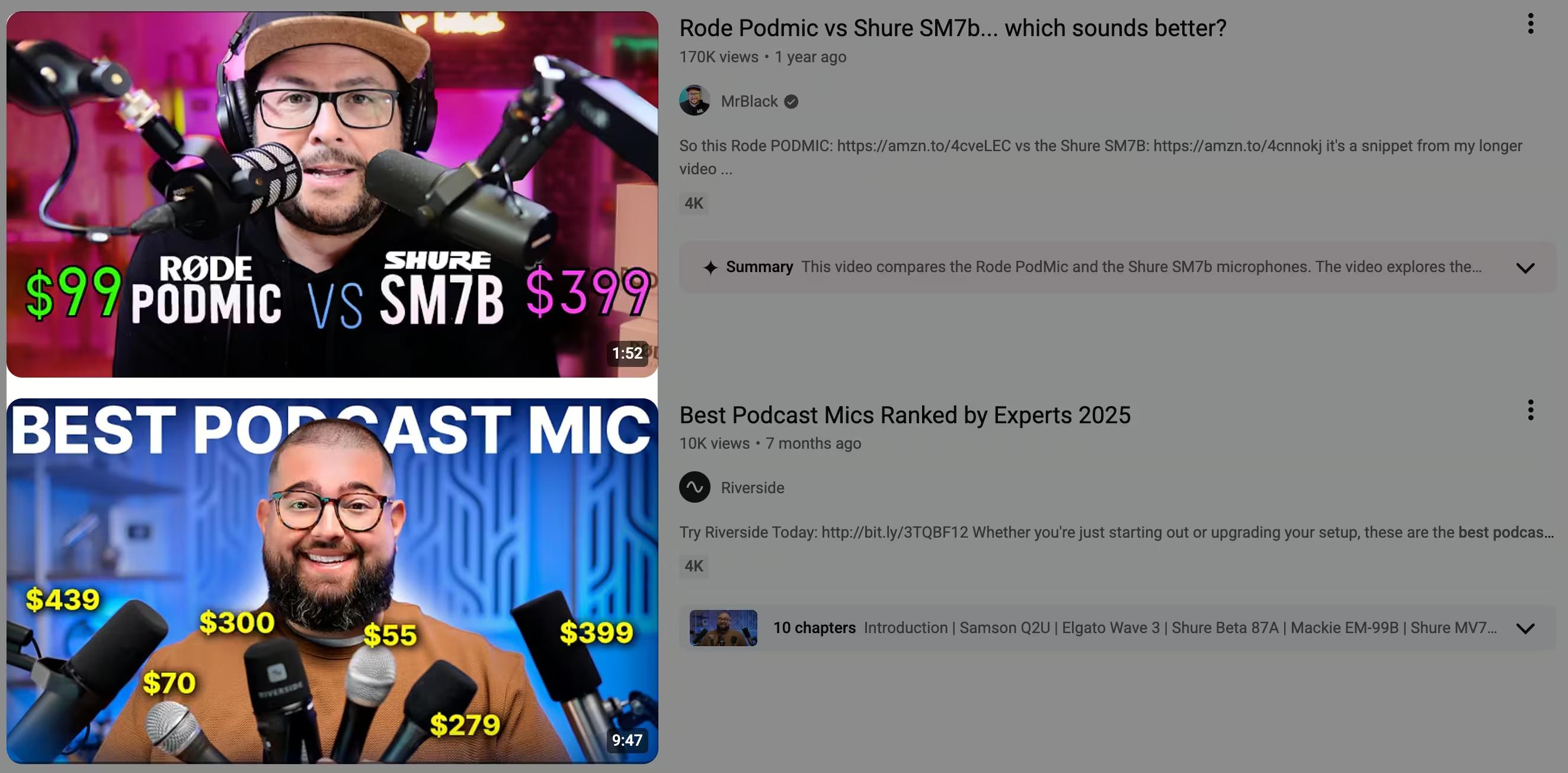
They'll show you how to pick a mic, choose a hosting platform, and hit publish.
What they won't mention is that 72% of podcasters say discoverability is their biggest challenge — or that the median episode gets about 141 downloads.
I've been creating content for over 14 years across multiple platforms. I chose writing over podcasting for a specific reason.
This guide covers when a podcast makes sense, when it doesn't, and the one metric every podcast guide ignores.
The Podcasting Landscape in 2026
Podcasting is not dead. Far from it.
There are roughly 619 million podcast listeners worldwide in 2026 — up about 7% from the year before. In the US alone, 55% of Americans listen to a podcast at least once a month. That's 158 million people.
But here's the other side of those numbers.
Over 4.5 million podcasts are indexed globally. Only about 436,000 are actively producing new episodes. That means roughly 90% of shows have already gone silent — a phenomenon the industry calls "podfade."
The audience is massive. The graveyard of abandoned shows is even more massive.
This doesn't mean you shouldn't start. It means the "just start a podcast!" advice is incomplete.
The shows that survive share a few traits: clear positioning, a specific audience, and a plan that goes beyond "record and hope."
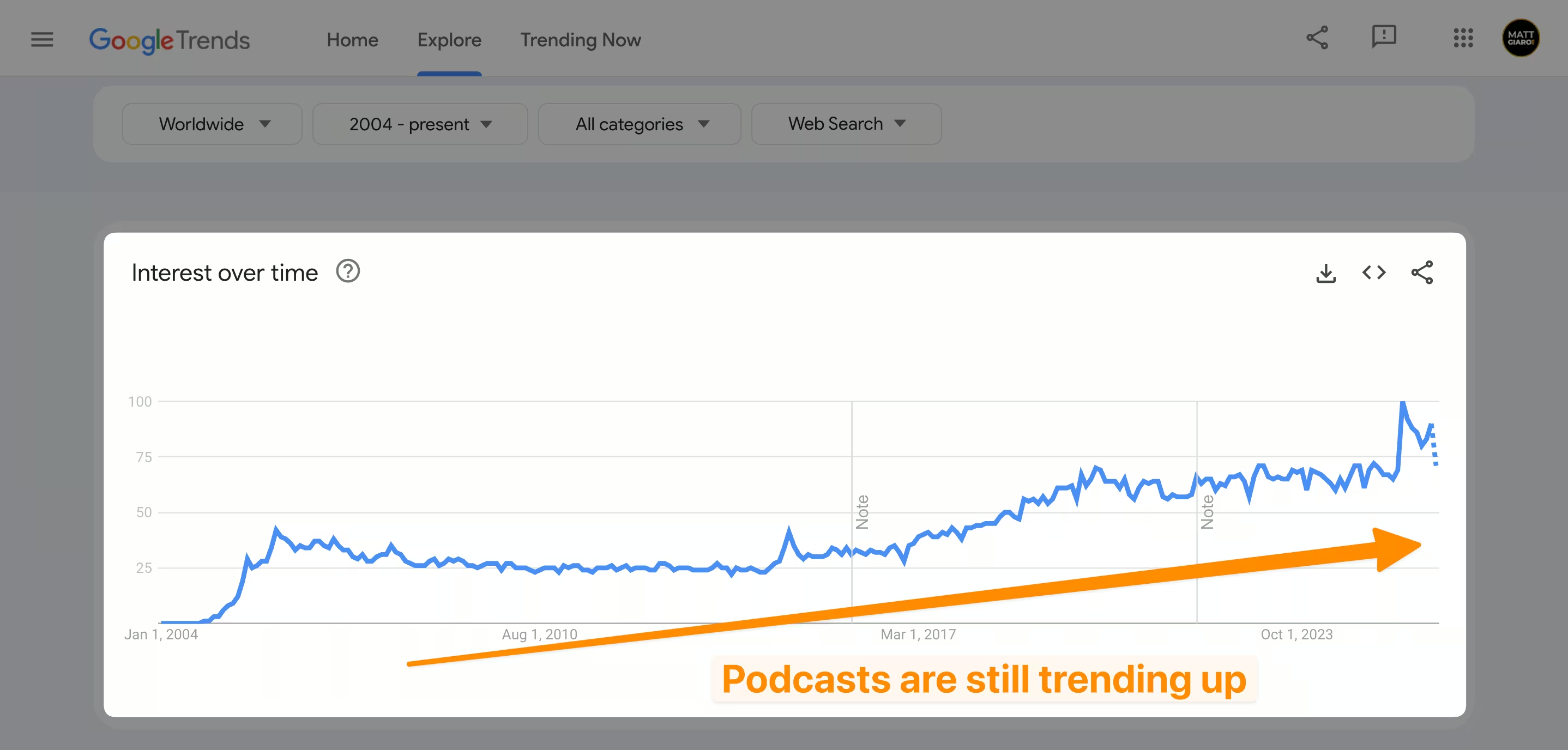
One encouraging sign: the 35–54 age bracket has shown consistent growth in podcast consumption, climbing 16% since 2022. The listeners are there.
The question is whether podcasting is the right channel for your specific business model.
When Starting a Podcast Makes Sense
Podcasting works when it aligns with three things: your energy, your audience's habits, and your business model.
You genuinely enjoy talking.
This sounds obvious. But it's the most common reason podcasts die. Recording, editing, and publishing every week requires a different kind of energy than writing.
If sitting down and talking for 30 minutes feels natural, that's a good sign. If it feels like a chore, it will become one.
Your audience already listens to podcasts.
If you're a business consultant, executive coach, or leadership trainer, your audience is likely consuming podcasts during commutes, workouts, and walks.
About 70% of listeners complete most or all of a 30–60 minute episode. That's an extraordinary amount of attention. No Instagram reel gets 30 minutes of someone's time.
You want to build deep trust.
Audio is intimate. A listener hearing your voice in their earbuds every week builds a different kind of relationship than reading a blog post.
For creators selling high-ticket offers — coaching, consulting, premium courses — that trust can be worth the slower growth.
You're willing to repurpose.
A single podcast episode can become a YouTube video, a blog post, newsletter content, and social media clips.
If you build your workflow around repurposing from the start, the time investment starts to make more sense.
When Starting a Podcast Doesn't Make Sense
This is the section most guides skip entirely.
If you're a creator with limited hours — squeezing content creation into mornings before work or evenings after the kids are in bed — you need to hear this.
Podcasts have a terrible discoverability problem.
Unlike YouTube (which has a search engine and recommendation algorithm) or blog posts (which can rank on Google), podcasts have almost no native discovery mechanism.
Apple Podcasts and Spotify surface recommendations, but they heavily favor established shows. There's no equivalent of "SEO for podcasts."
New listeners mostly find podcasts through word of mouth, social media, or being a guest on other shows.
This is exactly why so many creators now do video podcasts — turning the camera on while recording and publishing to YouTube. It's become almost mandatory if you want any algorithmic distribution.
But that also means your "simple audio podcast" now requires:
- A camera and decent lighting
- Video editing skills (or money to outsource)
- YouTube optimization (thumbnails, titles, descriptions)
The time investment just doubled.
Growth requires a network.
Unlike writing, where one well-optimized article can bring you traffic for years, podcast growth is relationship-driven.
You either need an existing audience to promote to, or you need to do collaborations — guest appearances, cross-promotions, joint episodes.
If you don't have a strong network or aren't comfortable building one through cold outreach, growth will be painfully slow.
The time cost is brutal relative to the output.
A single podcast episode — factoring in topic planning, recording, editing, show notes, creating clips, and publishing — takes 3–5 hours.
If you're also shooting video, add another hour or two. For someone with 5–10 hours a week for content creation, that's one or two episodes.
The same 5–10 hours could produce 3–5 written articles, each with built-in SEO discoverability.
Ad-based monetization is almost irrelevant for small shows.
Podcast advertising pays $15–25 per 1,000 downloads (CPM). The median show gets about 141 downloads per episode within 30 days.
Do the math. That's roughly $2–3 per episode in potential ad revenue. You'd make more money finding a quarter on the sidewalk.
I say this from personal experience. I like creating podcasts. But I don't like creating them every day.
As an introvert, audio and video formats require a lot of energy — energy I usually don't have during my morning content creation slot. So I chose writing instead.
Not because writing is inherently superior. Because I could actually stick with it.
The Real Cost of Podcasting
Equipment is the cheap part.
A decent USB microphone runs $60–150. A pop filter is $15. Free recording software (Audacity, GarageBand) works fine. Hosting starts at $5–15/month.
Total startup cost: $100–300.
That's not what kills podcasts. What kills podcasts is the invisible cost — your time.
Here's a realistic breakdown per episode:
- Topic planning and research: 30–60 min
- Recording: 30–45 min
- Editing (audio): 45–90 min
- Show notes and publishing: 30 min
- Creating social clips for promotion: 30–60 min
- Video editing (if doing video podcast): 60–90 min
Total: 3–6 hours per episode if you're doing the full production workflow.
But here's the nuance. You don't have to do all of that.
You can record a podcast episode on a walk. In your car before a meeting. On your phone while the house is quiet. The recording part is flexible in ways that video or polished writing aren't.
Where the real time sink hits is everything around the recording — editing, show notes, clips, promotion. That's where most creators underestimate the commitment.
Multiply a weekly show by 50 weeks. You're looking at 150–300 hours per year at full production. Less if you keep it lean.
The bigger issue isn't time. It's what happens after you hit publish.
A blog post can rank on Google for years, bringing in subscribers while you sleep. A podcast episode from three months ago? Unless someone scrolls through your back catalog, it's essentially invisible.
The good news: you can repurpose episodes into blog articles. Either with your own workflow or with any of the dozens of repurposing tools on the market right now. That way you get the trust-building power of audio and the discoverability of written content.
Podcasting vs Other Content Channels for Creators
Let's zoom out for a second.
If you're selling courses, coaching, or digital products, every piece of content you create serves one purpose: getting the right people onto your email list. That's where the relationship deepens. That's where the sale happens.
A podcast, a YouTube video, a blog post — they're all acquisition channels. Different doors into the same room.
The question isn't "which channel is best?" It's "which door fits the way I naturally operate?"
| Factor | Podcast | YouTube | Newsletter/Blog |
|---|---|---|---|
| Startup cost | $100–300 | $300–1,000 | $0–50 |
| Discoverability | Very low (no native search) | High (search + algorithm) | High (SEO + social) |
| Email list growth speed | Slow | Medium–Fast | Fast |
| Trust-building depth | Very high | High | Medium |
| Flexibility | Record anywhere, anytime | Needs camera + setup | Write anywhere, anytime |
| Main skill required | Talking clearly | Being on camera + editing | Writing clearly |
Notice I didn't include "time per piece" as a deciding factor.
Here's why. You can record a podcast on a walk. On your commute. In a parking lot before picking up the kids. The barrier isn't really time — it's whether talking into a mic feels natural to you or drains your energy.
Same goes for writing. Some people knock out a 1,500-word article in an hour. Others stare at a blank screen for three hours and produce two paragraphs. The "time cost" depends almost entirely on your personal wiring.
What does differ between channels — and what you can't change with effort — is discoverability.
A blog post can rank on Google and pull in subscribers for years without you touching it again. A YouTube video gets surfaced by an algorithm to people who never heard of you. A podcast episode? It mostly reaches people who already follow you — unless you're doing video podcasting on YouTube or actively collaborating with other creators.
That's the real tradeoff. Not time. Distribution.
If building your email list fast is the priority and you don't have an existing audience, written content or YouTube will get you there sooner. Podcasting builds deeper trust with the people it does reach — but it reaches fewer new people on its own.
The best setup for most creators? Pick the channel that matches your energy. Then make sure every piece of content points back to your email list.
For more on each channel, read Should I Start a YouTube Channel? and Is Starting a Newsletter Worth It?.
The Metric Most Podcast Guides Ignore
Here's something almost no podcasting guide will ever mention.
Every podcast platform — Apple, Spotify, Buzzsprout — gives you the same metrics: downloads, listen time, geographic breakdown, maybe device type.
These are all vanity metrics.
They tell you how popular an episode is. They don't tell you whether that episode made you any money.
Think about it.
You could have an episode with 500 downloads that brought zero email subscribers. And another with 80 downloads where three listeners joined your list and bought your $497 course.
That's $1,491 from the "flop" and $0 from the "hit."
Without tracking the content → subscriber → purchase chain, you'd celebrate the wrong episode and kill the one actually paying your bills.
This is the fundamental measurement gap in podcasting — and in all content creation.
Your platforms show you reach. They don't show you revenue.
I have blog posts with hundreds of thousands of views that didn't attract a single buyer. I also have YouTube videos with fewer than 3,000 views that brought in thousands of dollars in sales.
Views lie. Downloads lie.
The only truth is: which piece of content brought in subscribers who actually bought something?
How to Turn Podcast Listeners Into Email Subscribers
If you do start a podcast, there's one non-negotiable: every episode needs to drive listeners to your email list.
A podcast without a list-building mechanism is a hobby. Not a business tool.
But "hey, join my newsletter!" as your call to action is weak. Nobody wakes up wanting another newsletter.
Each episode needs a specific lead magnet tied to the topic you discussed.
If your episode is about time management for freelancers, offer a downloadable weekly planning template. Breaking down pricing strategies? Offer a pricing calculator spreadsheet.
Transcripts used to work as lead magnets. With AI, anyone can generate one in seconds. The value has evaporated.
You need something more specific:
- Templates and checklists
- Frameworks and swipe files
- Calculators or worksheets
- Condensed action plans
Things that go deeper than the episode itself.
Here's where it gets practical.
You need a unique link for each lead magnet so you can track which episodes actually pull subscribers onto your list. Something like go.yourname.com/time-template that you can say out loud during the episode.
This is exactly what BestSubscribers does.
You create branded tracking links with your own domain — make them up on the fly, no setup required — and then see exactly which episodes brought subscribers who eventually became buyers.
Not just "this episode got 300 downloads."
But "this episode brought 12 subscribers, and two of them bought your course."
That data changes everything. Instead of guessing which episodes to make more of, you know. Instead of measuring success by downloads, you measure it by revenue.
If You Decide to Start: The Minimum Viable Podcast
Read everything above and still want to start? Here's the lean path. No overinvesting before you've proven the concept.
1. Define the purpose.
Your podcast is a business asset. Not a creative experiment.
Before recording anything, answer one question: what do I want listeners to do after they listen? Join my email list. Book a call. Buy my course.
If you can't answer that, you're not ready.
2. Pick a specific audience.
"Entrepreneurs" is not an audience. "First-time managers in tech companies navigating their first year of leadership" is an audience.
The more specific, the easier every other decision becomes — topics, guests, format, promotion.
3. Start with a USB mic and your laptop.
A $60 Audio-Technica ATR2100x or Samson Q2U will sound professional enough. Record in a quiet room. Closets actually work great — zero echo.
Use Audacity or GarageBand for editing. Don't buy anything else until you've published 10 episodes.
4. Publish on a free or cheap host.
Buzzsprout, Libsyn, or RSS.com will distribute to Apple, Spotify, and everywhere else automatically.
Launch with at least 3 episodes so new listeners can binge.
5. Build your network from day one.
Podcast growth is relationship-driven. Reach out to other podcasters for guest swaps. Be a guest on other shows. Cross-promote with creators in adjacent niches.
If you're only publishing and hoping people find you, you'll be waiting a long time.
6. Connect every episode to your email list.
Create a specific lead magnet for each episode or series. Use branded tracking links (like go.yourname.com/episode-name) so you can measure which episodes drive subscribers — and which subscribers become buyers.
Set this up from episode one. Retrofitting tracking after 50 episodes is a nightmare.
The Bottom Line
Every content channel — podcast, YouTube, blog, newsletter — is an acquisition channel. A door that leads people to your email list, where the real relationship and revenue happen.
Podcasting builds trust like almost nothing else. There are 619 million listeners. The audience keeps growing.
But it has the weakest native discoverability of any major content channel. Without video, collaborations, and active promotion, new people won't find you. And the default metrics — downloads, listens — tell you nothing about whether your podcast is actually making you money.
The right channel is the one that matches your energy and that you can stick with for a year. If that's talking, podcast. If that's writing, blog. If that's being on camera, YouTube.
Whatever you choose, make sure every piece of content points back to your email list. And track which content brings in subscribers who actually buy. That's the only metric that matters.
BestSubscribers connects every subscriber back to the exact content piece — podcast episode, blog post, YouTube video, tweet — that brought them in. And shows you whether they became a buyer.
15-minute setup. Then it runs in the background while you focus on creating.
Start your free 14-day trial →
No. There are 619 million podcast listeners worldwide and only about 436,000 actively publishing shows. The market isn't saturated — but generic shows without a clear audience are. If you pick a specific niche and commit to consistency, the opportunity is real. The barrier isn't timing. It's whether you have a plan beyond "record and publish."
Through advertising alone, the math is brutal. Podcast ads pay $15–25 per 1,000 downloads. The median show gets about 141 downloads per episode. That's roughly $2–3 per episode in ad revenue. The real money for creators comes from using the podcast to drive email subscribers who buy your products — courses, coaching, consulting. Even a small show with 200 downloads can be profitable if the right listeners join your list and purchase.
Yes, but growth will be slow without an existing audience or network. The most effective strategy is to be a guest on established shows in your niche, do cross-promotions with other creators, and publish video versions on YouTube for algorithmic discovery. Building from zero with audio-only episodes and no promotion is the hardest path possible.
YouTube, in most cases. YouTube has a built-in search engine and recommendation algorithm that surfaces your content to new viewers. Podcasts have almost no native discovery mechanism. Many creators now record video podcasts specifically to get YouTube's distribution. If building an email list is your primary goal, YouTube or written content will grow your list faster.
Most podcasts need 3–6 months of consistent weekly publishing before seeing meaningful traction. The average growth rate is about 1.6% per month. Expect your first year to be a slow build. Shows that survive the first 25 episodes tend to find their rhythm. The ones that quit before then — and most do — never get past the discoverability valley.

Ready to see which content makes you money?
Stop guessing. Start tracking content to revenue.
Start Free Trial