 BestSubscribers
How to Build an Email List Without a Website (9 Methods That Work)
You can build an email list without a website by using a free landing page from your email platform (Kit, MailerLite, Beehiiv, etc), then driving traffic to it through social media, newsletter sponsorships, and publishing on platforms like Substack or Medium.
After 13+ years of building and monetizing email lists – here are 9 methods that actually work, ranked by how fast they produce subscribers who buy.
Why You Don't Need a Website to Start an Email List
A website is a nice-to-have, not a prerequisite.
All you actually need is a landing page and a way to get people to it.
Sure, building a website is easier than it was 15 years ago. But it still creates friction.
- Which host?
- Which platform?
- WordPress or Squarespace (or something else)?
For someone just starting, these questions can delay you for weeks before you collect a single email address.
You don't need any of that.
A website is a collection of pages serving multiple purposes. A landing page is a single page with one job — collect an email address.
Most email platforms include built-in landing page builders. Free, no code, no domain purchase needed.
The real bottleneck is never the website. It's traffic.
Most creators stall because they build a website and wait for visitors instead of going where people already are.
And here's a stat worth remembering: 75%+ of traffic you send to a landing page never comes back.
So conversion matters more than having a fancy site.
Pick Your Email Platform First
Before you collect a single email, you need an autoresponder.
It stores contacts, sends emails, and can host your landing page — all in one tool.
Here are three solid options:
-
Kit (ConvertKit): Best for creators selling courses and digital products. Free plan up to 10,000 subscribers. Built-in landing pages and automation.
-
MailerLite: Generous free plan (up to 1,000 subscribers), drag-and-drop landing page builder, solid automation. Great if you're starting on a budget.
-
Beehiiv: Free plan up to 2,500 subscribers, hosted signup forms with unique URLs, reliable deliverability.
What matters: hosted signup forms or landing pages, basic automation (welcome emails), and the ability to share a URL you can paste anywhere.
Don't overthink this. Pick one and start.
Your list is always exportable — you can switch later without losing a single subscriber.
Create a Lead Magnet People Actually Want
Nobody wakes up thinking, "I need to subscribe to more newsletters."
People sign up because they want something specific — a checklist, a template, a quick fix to a problem they have right now.
That's what a lead magnet is: a free resource someone gets in exchange for their email address. An ethical bribe.
Best formats right now are:
- short checklists,
- templates,
- cheat sheets,
- 5-day challenges
- email-based mini-courses
Throw that 50-page ebooks out of the window. Because nobody reads on their phone. (I don't know about you, but the last time I tried to read a PDF on a 6-inch screen, it killed my retina.)
The lead magnet needs to solve one narrow, specific problem. "5-minute morning routine for busy parents" beats "Complete guide to wellness."
Match it to your content topic.
If you write about email marketing, your lead magnet should be about email marketing. If you write about blogging, it should be about blogging. Alignment between your content topic and your lead magnet dramatically increases conversion.
Set Up a Landing Page in Minutes (No Website Required)
Your landing page is a single webpage with one job — collect an email address. You can build one without touching code or buying a domain.
Option 1: Use your email platform's built-in builder. Kit, MailerLite, and AWeber all have free landing page tools. Open your account → create a form or landing page → add headline + description + email field → publish → copy URL. Done. You now have a shareable link you can post anywhere.
Option 2: Use a dedicated landing page builder like RocketSubs if you want higher conversions without the guesswork.
RocketSubs lets you create high-converting landing pages in seconds — not hours.
It's a tool I'm in my business and built for myself because I was tired of wasting time doing it every time. It's purpose-built for creators collecting email subscribers, with conversion best practices already baked in.
No need to study landing page optimization or wrestle with generic page builders.
What makes a landing page convert:
- Clear headline stating what they get and who it's for
- 2–3 sentences describing the value
- Minimal form fields (email only or email + first name)
- One strong CTA button
- No navigation links, no sidebar, no distractions
What to avoid: cluttered design, too many links competing for attention, no clear value proposition, images so large they bury the opt-in field.
Here's the math that should motivate you: doubling your landing page conversion rate means doubling your subscribers with the exact same traffic. Most landing pages convert at 10–15%. A well-optimized one can hit 30%+.
Turn Social Media Followers Into Email Subscribers
Social media is rented land — your followers aren't yours. But it's the fastest free channel to drive traffic to your landing page when you have no website.
Put your landing page link in every bio. LinkedIn, X, Instagram, YouTube, Facebook — all of them.
Then create content that teases your lead magnet. Post a tip from the checklist, then: "I put all 7 steps into a free checklist — link in bio."
Some platform-specific tactics:
- LinkedIn: Articles and posts with a CTA to your landing page. Strong for professional expertise topics.
- X/Twitter: Pin a tweet promoting your lead magnet. Short, punchy, direct.
- Facebook: Use groups in your niche. Add genuine value first, promote second. Groups have better organic reach than pages.
- Instagram: Stories with link stickers, mention your lead magnet in Reels.
- YouTube: Description box link + verbal CTA in every video.
The importnant part here is that every piece of social content is a bridge to your email list.
Only 2–6% of your social followers see any given post.
Email reaches 98–99% of your list.
And when you're creating content on social platforms, you're on an ejectable seat. Your account can get suspended anytime.
Your email list is the only audience you truly own.
Publish on Substack or Medium to Grow Your List for Free
Substack and Medium are free publishing platforms with built-in audiences. You borrow their traffic to build your own list — no website needed.
Substack is essentially a free newsletter platform with a built-in reader network. Every subscriber is automatically on your email list. You can publish, grow, and email from Substack alone.
I've been averaging 300–500 new subscribers per month on Substack. In one year, I added 6,123 subscribers to my list — spending about 45 minutes a day.
Medium has a recommendation engine that surfaces your articles to readers based on their interests. Add a CTA linking to your landing page at the end of every article.
I've racked up over 500,000 views on Medium, and thousands of readers subscribed to my email list from the platform.
Why these beat starting a blog from scratch: readers are already there. You don't build a site and hope people show up — you publish where they already browse.
The tradeoff: you don't own the platform. Use them as growth channels, but always funnel subscribers to your own email list through your autoresponder for full ownership and control.
Pro tip: every article should promote a lead magnet at the end. Not "subscribe to my newsletter" — that doesn't work anymore.
Give them something specific.
Sponsor Other Creators' Newsletters
Newsletter sponsorships are the fastest way to get subscribers when you're starting from zero.
You pay a creator with an existing audience a small fee to feature your lead magnet in their email — and wake up to dozens of new subscribers overnight.
How it works: find creators who already have an email list in your niche. Pay them roughly $200 (sometimes less) to promote your lead magnet in one of their emails.
Their subscribers click, land on your page, and opt in.
Why this beats organic when you're starting out: organic content takes months to gain traction. Sponsorships produce subscribers within 24 hours. You skip the "shouting into an empty room" phase.
I've spent over $10,000 on newsletter sponsorships and added 2,044+ subscribers to my list. Most sponsorships paid for themselves through backend product sales. Some real numbers:
- $40 sponsorship → $294 in sales
- $50 sponsorship → $3,194 in sales
- $100 sponsorship → $388 in sales
Not every sponsorship prints money like that. But the winners more than cover the losers.
Why sponsorships are more beginner-friendly than swaps: swaps require roughly equal list sizes. If you're at 50 subscribers, nobody with 5,000 subscribers wants to trade. Sponsorships remove that barrier — you're paying for access, not trading.
Where to find newsletter sponsorships: reach out to creators directly (check their "about" or "sponsor" pages), or browse social media to find more creators in your niche you could potentially sponsor.
Another option: beehiiv Boosts.
If you're on beehiiv's Scale plan ($49+/month), you can deposit funds and pay other newsletters per subscriber. Average cost per subscriber reportedly around $2.25. They also offer "magic links" — URLs that auto-subscribe someone with a single click, no form needed. The convenience is real, but the caveat: some people click accidentally and end up subscribed without intent. Worth testing, but watch your engagement metrics.
Whether you use direct sponsorships or a marketplace, the math is simple: if your backend product earns back what you spent, you built a profitable list for free.
Do Newsletter Swaps With Other Creators
A newsletter swap is when you and another creator promote each other's lead magnet to your respective lists.
Free, effective — but requires roughly equal list sizes to work.
How it works: find a creator with a similar-sized audience in your niche. You send an email promoting their lead magnet; they send one promoting yours. Both lists grow. Cost: $0.
The catch: swaps work on reciprocity.
If you have 100 subscribers and approach someone with 10,000, they'll decline. You need to be in roughly the same ballpark.
That makes swaps more realistic once you've built some initial momentum (500+ subscribers) — not necessarily day one.
Where to find swap partners:
- creator communities,
- Substack Notes,
- X/Twitter DMs,
- SparkLoop,
- newsletter directories like Lettergrow.
Pro tip: write the email for them. Provide a ready-to-send draft promoting your lead magnet so all they do is copy-paste. This reduces friction dramatically.
Adding urgency helps too: make your lead magnet available for a limited time (48 hours) to their audience. Real scarcity drives action. (If you use BestSubscribers, the expiring links feature does this natively — the link automatically redirects after the deadline.)
Swaps will not flood your email list with thousands of subs overnight.
But it will probably add quality subs to your list.
Not long ago, I ran a swap that brought in only 27 subscribers. Looked like a failure on paper.
But one of those 27 spent $1,500 on my products.
Without tracking, I would've written it off.
Guest Post on Blogs and Podcasts in Your Niche
Borrowing someone else's audience is faster than building your own from scratch. Guest content puts you in front of people who already care about your topic.
Guest blogging: Write a valuable article for a site in your niche. Include a link to your landing page in your author bio. Time-intensive, but one well-placed article can drive hundreds of subscribers.
Podcast guesting: Pitch yourself as a guest on podcasts your audience listens to. Mention your lead magnet during the episode and in the show notes. Lower effort than writing a full guest post.
I've interviewed creators like Ben Settle, Tiago Forte, Terry Dean, and Mike Dillard on my podcast — close to 300,000 combined email subscribers between them.
When these episodes went live, some of them shared it with their audiences.
Some of those listeners opted into my email list.
Always direct people to your landing page — not "check out my website" or "follow me on Instagram."
Run a Giveaway to Kickstart Your List
Giveaways create urgency and leverage the fact that people love free stuff. They produce a burst of subscribers quickly — but quality varies.
How it works: offer a prize (your product, a partner's product, or a curated bundle) in exchange for an email signup. Tools like UpViral, RafflePress, or ViralSweep handle the mechanics.
The results can be dramatic. Rafflecopter grew from 0 to 35,000 subscribers using giveaways. Foundr got 13,603 signups in 10 days.
But here's the quality caveat: giveaway subscribers often have lower engagement and purchase rates.
Many sign up for the prize, not for you.
Segment them separately and watch who actually engages before treating them like regular subscribers.
Partner with businesses in your niche to get prizes in exchange for exposure. You'd be surprised how many will say yes if you position it as mutual benefit.
Giveaways are a good kickstart tactic, not a long-term strategy. Use them to get initial momentum, then switch to sustainable methods like content, sponsorships, and swaps.
The Metric Nobody Talks About: Which Subscribers Actually Buy?
Every article about list-building obsesses over subscriber count. None ask the more important question: which of these tactics produce subscribers who spend money?
The uncomfortable truth: your most viewed content and your most profitable content are almost never the same thing.
I have a YouTube video with 154,000+ views. It generated zero customers. Zero.
Another video with fewer than 3,000 views brought in thousands of dollars in course sales.
If I'd followed views as my guide, I would've doubled down on the wrong content and killed the stuff that was quietly making me money.
Remember the swap example?
27 subscribers. Looked like a dud. But ONE of them spent $1,500.
Want another example?
A $50 newsletter sponsorship that only brought 32 email subs generated $3,194 in backend sales.
Without attribution, both look mediocre on paper.
The problem is structural.
Instagram won't tell you which posts generated subscribers. LinkedIn won't show you which articles led to sales. YouTube won't connect views to revenue. The platforms where you grow don't track the things that matter.
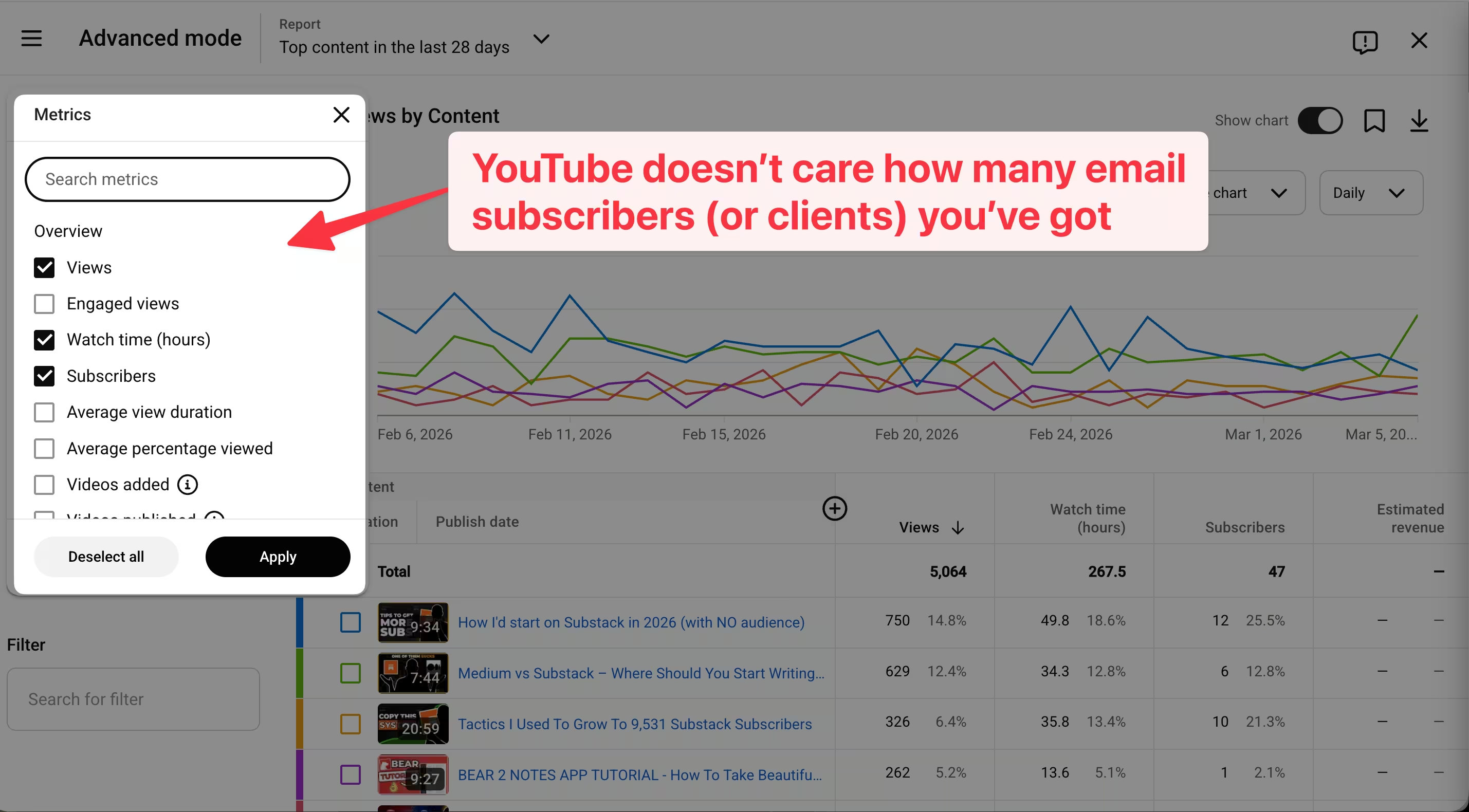
I tried tracking this myself for years. Spreadsheets, UTM parameters, janky Zapier automations. Even then, at least 30% of my revenue went untracked.
From day one, track not just where subscribers come from, but whether they purchase. That's the difference between growing a list and growing a business.
That's why I built BestSubscribers — it connects every subscriber back to the content that brought them in and shows whether they bought. So you know which of these 9 tactics actually makes you money, not just makes your subscriber count look bigger.
If you want to go deeper on this concept, here's an article on what content attribution is and why every creator needs it.
Start Building Your Email List Today
You don't need a website to build an email list. You need a landing page, a lead magnet, and one traffic source.
Start with the method that fits where you are right now. If you have a few hundred dollars, try a newsletter sponsorship and get subscribers this week. If you're bootstrapping, publish on Substack or Medium and grow for free.
The best strategy is the one you'll actually do consistently.
Pick one method from this article. Set it up this week. And if you want to know which method actually brings in buyers (not just subscribers), start tracking from day one with a free 14-day BestSubscribers trial.
Yes. All you need is an email platform (Kit, MailerLite, or AWeber) with a hosted signup form or landing page builder. You get a shareable URL you can post anywhere — social media, DMs, podcast show notes, email signatures. No domain or hosting required. For higher conversions, use a dedicated landing page builder like RocketSubs.
Kit (ConvertKit) offers a free plan for up to 10,000 subscribers with built-in landing pages. MailerLite's free plan covers up to 1,000 subscribers with automation and landing pages. AWeber's free plan supports up to 500 subscribers. All three let you build and share landing pages without a website.
Create a specific lead magnet that solves one problem your audience has. Set up a landing page. Share the link in your social media bios and in every piece of content you publish. If you have budget, sponsor 2–3 newsletters in your niche — you can add dozens of subscribers overnight for around $100 each. Most creators can hit 100 within 2–4 weeks using a combination of these methods.
Absolutely. Your list is an asset you build before you need it. When you launch a product, you already have people waiting to buy. You can also use your list to validate ideas — ask subscribers what they'd pay for, and their responses guide your product creation. A list of even 100 engaged subscribers is enough to test and sell a first offer.
A website is a collection of pages (blog, about, shop, contact) serving multiple purposes. A landing page is a single page with one goal — usually collecting an email address. You can create a landing page in minutes inside your email platform or with a tool like RocketSubs, without building a full website.
Yes — sponsorships are one of the most beginner-friendly ways to grow a list because they don't require an existing audience, months of content, or technical skills. You pay a creator to feature your lead magnet in their newsletter. If your backend product earns back what you spent, you've built a profitable list segment for free.

Ready to see which content makes you money?
Stop guessing. Start tracking content to revenue.
Start Free Trial